
How to Measure the TOTAL RISE of your Stairs
Measuring the Total Rise of your Stairs can be as simple as just measuring the distance from your top landing to the ground below. Unfortunately though, this is not always the case. There are some critical factors you need to be aware of and here’s the reason why!
You need to ensure that your top step and your bottom step are the same heights (Rise) as the rest of your stairs.
Therefore here are the considerations.
Firstly, if your top step is to be positioned below the landing (as in most cases). You need to ensure the height from the finished step to the top of the finished landing (the Rise) is the same as the rest of your steps you need to consider the following.
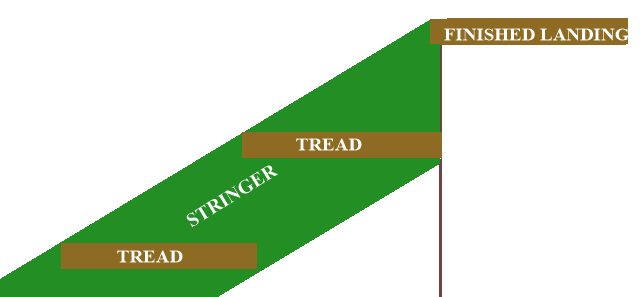
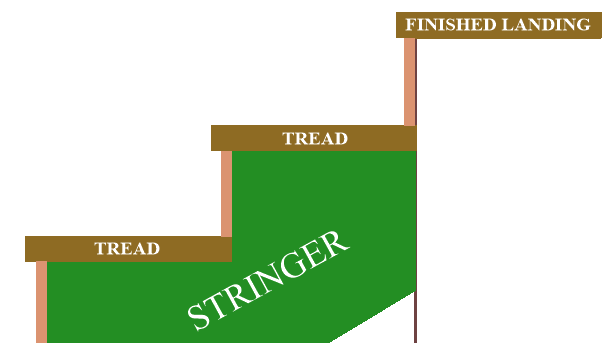
There are 2 common configurations of attaching your steps/treads to the stringers.
 |
|
Firstly, you can fit them between the stringers, which is common with outdoor stairs. Or you can cut out the Rise and Run profile on top of your stringers and then fit the Treads and Risers to the outside of the profile. So if you are using the second configuration then you do need to be be careful.
If the top surface of the landing is finished, then you need to deduct the thickness of your step Tread from the Total Rise measurement taken from the top of the finished landing. This will be the real Total Rise which should be used in the Stair Calculator. Then when you position the top of the stringer it needs to be the height of the calculated Rise (from the calculator) plus the tread thickness from the top of the finished landing.
See diagram below.
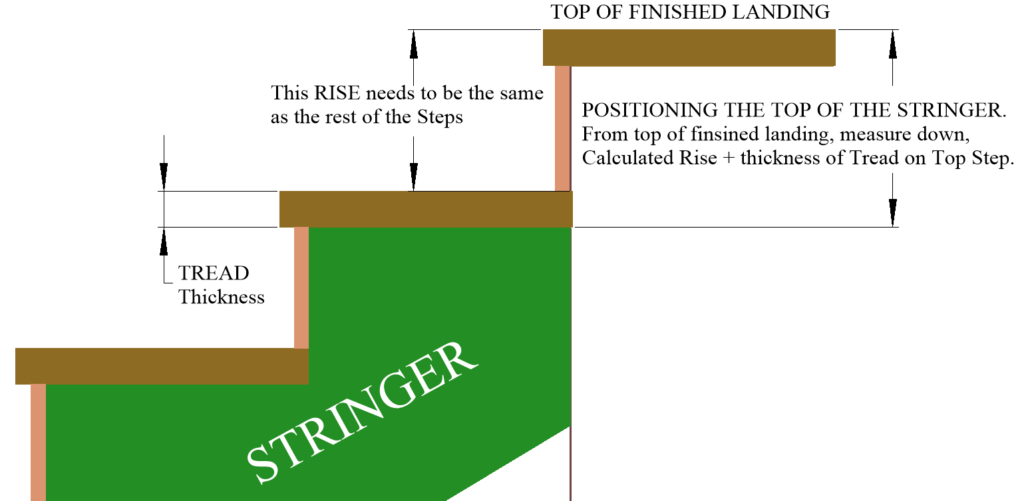
Next if your landing is not finished, and the material covering it is a different thickness to the tread, then you need to account for this as well.
See Diagram below
The next consideration you may be confronted with when measuring the Total Rise can be unlevel ground at the bottom of the stairs.
Have you ever walked down steps from a deck into a backyard, where the ground slopes away, and found the bottom step was much greater than you expected it to be. Or when the ground slopes upward and the last step was much less? You can trip or lose your balance, therefore it is important the get the height of the last step correct. So taking accurate measurements is important
Therefore now it’s not just a case of taking a vertical measurement from your top landing.
Therefore how do you go about measuring it?
There are several methods, but a simple one is to attach a string line where you think the top end of the stringer might end, just below the landing, and then angle it at the approximate angle you require and fix it to the ground. Now you know the approximate position that the stairs will meet the ground.
Now you can use a laser level to measure the vertical distance (Total Rise). Then use a tape measure along the string line to get the approximate stringer length. Or if you have a close wall to use as reference you can measure the horizontal distance to get the Total Run. Then you can use the Total Run and Total Rise dimensions to refine the rest of your dimensions using Stairs Calculator 3.